Monday, January 24, 2011

ANAEMIA

When blood is pumped to the lungs, carbon dioxide is exchanged for oxygen; the carbon dioxide is exhaled and oxygenated blood is returned to the heart. The amount of oxygen carried depends on the amount of haemoglobin in the red blood cells. Anaemia occurs when the amount of red blood cells or the amount of haemoglobin is reduced. In practical terms, being anaemic is like a car running on standard instead of super.

Haemoglobin is a substance made of an iron-containing, red pigment called haem, bound to four protein chains called globulins. A healthy male adult should have a haemoglobin level between 13.0 and 18.0 g/dl ( grams per 100 mls ). Because of normal menstrual loss, most women have a slightly lower haemoglobin level, usually between 11.5 and 16.5 g/dl. There is a growing trend to express haemoglobin levels in the International Unit, grams/litre or g/l. In these units the normal ranges are 130 to 180 g/l for men and 115 to 165 g/l for women.

Friday, January 21, 2011

Pictures: Best Amateur Astronomy Images Announced

Goblin Grin

Image courtesy Manuel Mejias via ESO

Looking like a ghoulish Halloween mask in this winning photo, the so-called N44 superbubble shines in vibrant color thanks to Manuel Mejas from Argentina, who processed raw data from the Very Large Telescope to create the scene.

The superbubble is a nebula complex 160,000 light-years away in the Large Magellanic Cloud, a satellite galaxy of the Milky Way. The bubble itself measures about 325 light-years across. Astronomers suspect the bubble was carved by fast stellar winds blown by a central cluster of stars. Additional star formation is thought to be triggered by the expanding gas shells of superbubbles such as this one.

Tuesday, January 11, 2011

the world's largest mirror -- Salar de Uyuni, Bolivia
The Salar is one of the iconic images of Bolivia, a massive salt desert in the middle of the Altiplano. It is an expansive, virtually flat desert that reflects the sun in such a way as to create a mirror effect with the sky. There are several lakes in the desert with strange colours from the mineral deposits in the region.

Some 40,000 years ago, the area was part of Lake Minchin, a giant prehistoric lake. When the lake dried, it left behind two modern lakes, Poopó Lake and Uru Uru Lake, and two major salt deserts, Salar de Coipasa and the larger Uyuni. Uyuni is roughly 25 times the size of the Bonneville Salt flats in the United States. It is estimated to contain 10 billion tons of salt, from which less than 25,000 tons is extracted annually

Friday, January 7, 2011

Necker island... a fantasy in real life


This is Sir Richard Branson’s Necker Island. Available for $53,000 per night if you count to take 28 favorite people with you and it comes with a staff of 60 employees. It is located in the British Virgin Islands and is 74 acres of land that is surrounded by beautiful sandy beaches, coral reefs, and gorgeous blue water.

very exclusive , places where i can only dream of going but never actually set foot on.. well if good luck and fortune are on me .. maybe, just maybe..


this is what make me go WOW!, surely for those who are into diving will surely love this baby. this private island paradise now has a new world-first - a 3-person aero submarine called Necker Nymph. This underwater 'aircraft' has been designed especially for Virgin Limited Edition and takes exploration under the sea to a whole new level.

Two passengers sit either side of a trained pilot who will take the submarine down to as deep as 30 metres below the surface. Once you've buckled up you'll have front row views of some spectacular marine life without having to swim around with all the usual scuba gear. Necker Nymph can travel at speeds of up to 6 knots underwater, and dives typically last between one and two hours.

so anyone up for a vacation???

Wednesday, November 17, 2010

do you believe in these????

1. Feeling in love is not much different from having a bad obsessive-compulsive disorder
The finding that romantic love is biochemically indistinguishable from having severe obsessive-compulsive disorder, published in Psychological Medicine, won psychiatrists led by Donatella Marazziti of the University of Pisa, Italy, the Ig Nobel prize for chemistry in 2000.

2.Coffee drinkers are more likely to see dead people

According to a research, heavy coffee drinkers are more likely to have hallucinations or feel "the presence of dead people,". A UK-based study quizzed 200 students on their caffeine intake and found those with the highest consumption were also more prone to report seeing, or hearing, things that were not there. Those who consumed a daily equivalent of seven cups of instant coffee or more - high caffeine users - were three times more likely to have extra-sensory experiences than low users, who had less than one cup daily. The Durham University study took in all caffeine consumption including coffee but also tea, caffeinated energy drinks or chocolate bars and caffeine pills.

When under stress, the body releases a stress hormone called cortisol. More of this stress hormone is released in response to stress when people have recently had caffeine. It is this extra boost of cortisol which may link caffeine intake with an increased tendency to hallucinate, say the scientists.

Thursday, October 21, 2010

New Deep-Sea Pictures: Snailfish, Eels Found in Trench

Image courtesy Oceanlab, University of Aberdeen

It's no apparition—this new species of ghostly white snailfish was photographed swimming at depths of 4.3 miles (7 kilometers) during a recent expedition to the Peru-Chile trench in the southeastern Pacific Ocean.

The deepest dwelling vertebrates on Earth, snailfish have been discovered inocean trenches in other parts of the Pacific. The deepest known fish, found at 4.8 miles (7.7 kilometers), are snailfish filmed in the Japan trench in 2008.

"The tantalizing thing is we've got a very clear photo of the species," said Monty Priede, director of Oceanlab at Scotland's University of Aberdeen, which co-sponsored the expedition. "No one has ever seen this before, and it's never been captured before."

Living so far underwater, the newfound, 6-inch-long (15-centimeter-long) snailfish can withstand pressures equal to 1,600 elephants standing on the roof of a Mini Cooper, according to Oceanlab.

"If you saw that fish in the aquarium you wouldn't say, Wow that's weird," Priede said. "But at a molecular level, in the details of its biochemistry, it is highly adapted in order to survive the high pressure."

Christine Dell'Amore

Published October 14, 2010


Photo in the News: Star Explosion Highlights "Purple Rose of Virgo"


March 29, 2007—Lightning may never strike twice in the same place, but star explosions apparently can.

For the second time in 11 years, the galaxy known as NGC 5584 is garnering attention as the brightly colored home of a brilliant supernova.

Located about 75 million light-years away in the direction of the constellation Virgo, NGC 5584 is slightly smaller but similar in shape to our own galaxy, the Milky Way. Scientists suspect that, like the Milky Way, the "purple rose" galaxy houses an energetic and supermassive black hole at its center.

Now that center is being outshined by SN 2007af, the brightest supernova seen so far the year. Visible as a white dot below and to the right of NGC 5584's center, the explosion was detected on March 1 by the European Southern Observatory's Very Large Telescope.

Supernovas of this kind—called Type 1a—usually occur in binary systems, when a compact star called a white dwarf draws matter away from its companion. When it gains enough mass, the white dwarf collapses under the pressure—setting off a cosmic fireworks show and sending matter hurtling off in excess of 9,300 miles (15,000 kilometers) a second.

Type 1a supernovas are rare, but researchers know enough about them to use the explosions as cosmic yardsticks for measuring distance and studying the early expansion of the universe.

The explosion 11 years ago, however, was a much more puzzling type of supernova, and scientists remain baffled by what caused that explosion.

There may be more discoveries ahead for this busy galaxy, however. The luminous patches dotting NGC 5584's disk are stellar nurseries, where new stars are being formed at a prodigious rate, astronomers say.

—Aalok Mehta

Wednesday, October 20, 2010

Sea Pig - One of the Ugliest Sea Creature | PlanetOddity.com

Sea Pig - One of the Ugliest Sea Creature | PlanetOddity.com


To the common man sea pigs may look like sea creatures produced from a cross between a pig and a slug. To some others it appears to be human fingers growing out of the creature’s mouth. But scientifically, these ugly sea pigs are scotoplanes or sea cucumbers belonging to the genus of the deep sea Holothurians.

sea pig 1

These Holothurians are marine animals that inhabit the deep sea floor. Some other examples of deep sea marine life include Sea squirt, sea stars, sea slugs, corals, clams, sponges and sea urchins. The Sea pigs may look like slugs. Their body wall skeleton is clearly visible as spiny C shaped rods and are clear cucumbers measuring2-4 inches in length. They have tentacles and large tube feet. The tube feet may appear like two antennas, while the other tube feet are arranged in a row around the rim at the bottom.

Sa pigs thrive best on the abyssal plain of the ocean floor and behave like slugs do above sea level. The sea cucumbers feed on deep ocean mud and thrive on the organic material present there. The sea pigs feed by using their tentacles to push the food into their mouth. They tread deep sea waters using their tube feet. Other sea organisms present here are starfish, sea urchins, clams and other members of the echinodermata family.

Mills and colleagues from the New Zealand’s National Institute of water and atmospheric pressure collected 30,000 deep sea animals including the sea pigs during a marine census of southern Antarctica. The sea pigs are available in abundance all over the world except the northern part of the Atlantic Ocean and eastern part of Pacific Ocean, and in central and South America.

sea pig 5

The sea pigs feed and reproduce in the depths of the ocean and form the majority of deep sea marine population. The sea pigs are not considered as a threat to humans and they are not an endangered species.

sea pig 6


Wednesday, September 15, 2010

eGFI – Student Blog � Solar Cells from Bioluminescent Jellyfish

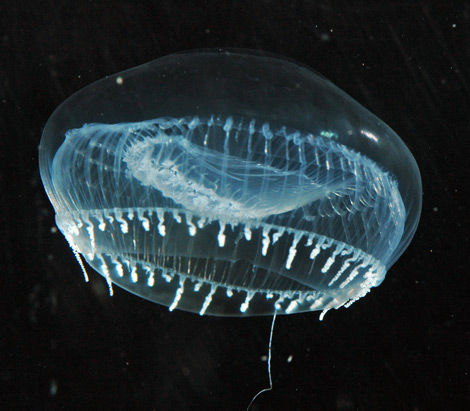
Swedish researchers are making photovoltaic technology come alive – literally. Zackary Chiragwandi and his colleagues at Chalmers University of Technology have found a way to create cheaper solar cells using special proteins harvested from bioluminescent jellyfish.

These glowing proteins, known as green florescent proteins (GFP), are inserted between two aluminum electrodes, where they form strands connecting the two plates. When exposed to UV light, the GFP generates current by absorbing photons and emitting electrons.

So why look to jellyfish for the future of solar cells? For one, these creatures are currently overpopulating some areas of the ocean, so they are not in short supply. Second, GFP could ultimately make for a wider variety of solar cells, including ones that work at the nano scale, and even those that can produce their own source of light.

Image: Sierra Blakely/Wikipedia

eGFI – Student Blog � Solar Cells from Bioluminescent Jellyfish

Monday, July 12, 2010

Highest Waterfall in the World - Tallest in the United States - GEOLOGY.COM


Highest Waterfall in the World - Tallest in the United States - GEOLOGY.COM


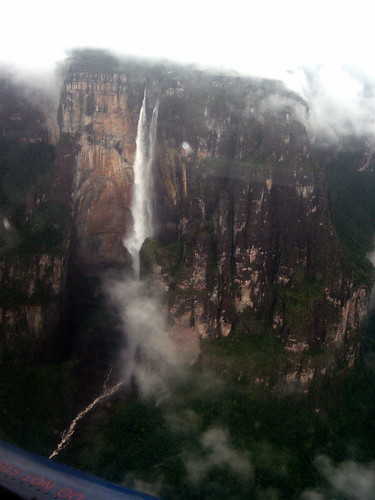
Angel Falls (Salto Ángel) in Venezuela is the highest waterfall in the world. The falls are 3230 feet in height with an uninterrupted drop of 2647 feet. Angel Falls are located on a tributary of the Rio Caroni. The falls are formed when the tributary stream falls from the top of Auyantepui (a tepui is a flat-topped structure surrounded by cliffs - similar to a mesa).

Saturday, June 26, 2010

Narwhal Monodon monoceros


A newborn narwhal calf is about 5 feet (1.5 meters) long and can weigh 175 to 220 pounds (79 to 100 kilograms). Narwhals are normally found in pods of two to ten.

Photograph by Paul Nicklen

The narwhal is the unicorn of the sea, a pale-colored porpoise found in Arctic coastal waters and rivers. These legendary animals have two teeth. In males, the more prominent tooth grows into a swordlike, spiral tusk up to 8.8 feet (2.7 meters) long. The ivory tusk tooth grows right through the narwhal's upper lip. Scientists are not certain of the tusk's purpose, but some believe it is prominent in mating rituals, perhaps used to impress females or to battle rival suitors. Females sometimes grow a small tusk of their own, but it does not become as prominent as the male's.

Narwhals are related to bottlenose dolphins, belugas, harbor porpoises, and orcas. Like some other porpoises, they travel in groups and feed on fish, shrimp, squid, and other aquatic fare. They are often sighted swimming in groups of 15 to 20, but gatherings of hundreds—or even several thousand—narwhals have been reported. Sometimes these groups become trapped by shifting pack ice and fall victim to Inuit hunters, polar bears, or walruses.

Inuit people hunt the narwhal for their long tusks and their skin, an important source of vitamin C in the traditional Arctic diet.

Wednesday, June 9, 2010

Futuristic Diving Helmet


Futuristic Diving Helmet

Information from Mobiitech said that recently has made a Diving Helmet to make divers easy to dive. Company that has made the concept of this future diving helmet is Yanko, it looks very futuristic both in terms of concept and materials to be used in manufacture. Still according to the same source said that the diving helmet made of glass and LED. A device called the HUD is mentioned will help divers in view of the GPS and find out the remaining air tanks performance. Silicon will be used as a seal between the diver's head 'and a helmet. Irrespective of whether this concept will work in the sea, but this could be a lesson for the development of helmet divers to make divers easier in research.

River under the Sea

River under the Sea

If you do love diving and do a diver, it is a good idea to visit the Cenote Angelita, Mexico. There is underwater river. Underwater rivers can be found in a cave if dive up to 30 meters depth, the water is freshwater, but if you dive to the depth of more than 60 meters, the water becomes salt water. In essence there is a "river" complete with trees and foliage. But, of course it was not unusual because the river is a river of hydrogen sulfide layer that looks like a river. Hydrogen sulfide, H2S, is a colorless gas, toxic, flammable, and smells like rotten eggs. These gases can arise from biological activity when bacteria break down organic material in a state without oxygen (anaerobic activity), such as in the swamp, the sea and sewage. Gas was also featured on the gas arising from volcanic activity and natural gas.

Friday, May 21, 2010

Signs and flowers

Aries (21 st March – 19 th April)
Aries flower – Thistle


Taurus (20 th April – 20 th May)
Taurus flower – Freesia


Gemini (21 st May – 21 st June)
Gemini flower – Rose


Cancer ( 22 nd June – 22 nd July)
Cancer flower – Crysanthemum


Leo (23 rd July – 22 nd August)
Leo flower – Sunflower


Virgo (23 rd August – 22 nd September)
Virgo flower – Lily


Libra (23 rd September – 22 nd October)
Libra flower – Daisy


Scorpio ( 23 rd October – 21 st November)
Scorpio flower – Gerbera


Sagittarius (22 nd November – 21 st December)
Sagittarius flower – Pink tulip


Capricorn (22 nd December – 19 th January)
Capricorn flower – Pink carnation


Aquarius (20 th January – 18 th February)
Aquarius flower – Orchid


Pisces (19 th February – 20 th March)
Pisces flower – Violet


Others flowers for your zodiac:
• Aries: red roses, tulips, amaryllis;
• Taurus: iris, lavender, lilac, aster, sweet pea;
• Gemini: ranunculus, acacia, daffodil, geraniums;
• Cancer: rose, delphinium, hydrangea, iris;
• Leo: marigold, gerbera, carnation, dahlia, sunflower;
• Virgo: chrysanthemum, gladiolus, veronica, violet;
• Libra: cyclamen, gardenia, tea roses, freesia;
• Scorpio: amaranthus, orchid, hibiscus, peony;
• Sagittarius: azalea, anemone, carnation, crocus;
• Capricorn: poinsettia, snowdrop, jasmine;
• Aquarius: arum lily, bird of paradise, protea, tulip;
• Pisces: madonna lily, zinnia, white lilac, gypsophila;

Wednesday, May 19, 2010

Sleep Underwater in the Maldives


Sleep Underwater in the Maldives

The world's first undersea restaurant opened 5 years ago this month at the Conrad Maldives Rangali Island, and to celebrate the anniversary the restaurant is offering guests the chance to not only eat under the sea but sleep under it as well. The 12-seat restaurant will be converted to a private bedroom suite for two, complete with private champagne dinner and breakfast in bed.

Ithaa sits five meters below the surface of the Indian Ocean, encased in plexiglass and reached by descending a spiral staircase. The restaurant offers breathtaking views and 'fusion Maldivian cuisine' (local
cooking with a western twist), and rumor has it that over lunch the place is so bright that guests and staff have to wear sunglasses (they even keep spares on hand and offer a sunglasses cleaning service). Sounds wonderful, although I imagine seeing the sun rise while eating breakfast in bed is even better.

Tuesday, May 18, 2010

The Great Blue Hole of Belize, World's Deepest Sea-Hole | PlanetOddity.com


The Great Blue Hole of Belize, World's Deepest Sea-Hole | PlanetOddity.com

If you ever come by near the coast of Belize, you shouldn’t miss an opportunity to visit the Great Blue Hole, one of the world’s most recognizable natural wonders. The Great Blue Hole is located in Belize Barrier Reef Reserve System, about 60 miles away from Belize City. It is believed that this hole is the world’s largest sea-hole. It is about 125 meters deep and its diameter is about 300 meters wide. It has been created as a cause of sea level increase about 65,000 years ago.Its almost perfect circular shape made it very popular amongst tourists who often visit this place. This place is most attractive for scuba divers who are exploring the depths of this hole. It is known that there are a plenty of cave networks in this place. Divers are also attracted with plenty of rare animal species and forms of life which can be found only in this place.

The Mysterious Sailing Stones of Death Valley | PlanetOddity.com


The Mysterious Sailing Stones of Death Valley | PlanetOddity.com

The mysterious sailing stones of Death Valley have been discovered to slide over valleys that people do not live in. These valleys are filled with dry cracking muddy ground during summer and ice during winter. Many geologists have gone to all the places in Racetrack Playa and its surrounding.The mysterious sailing stones of Death Valley slide on very smooth ground and leave a trail behind. Some geologists came up with the conclusion that the mysterious sailing stones of death valley move through the smooth ground when the mud is wet and the stones have little ice droplets on them with the help of the wind. This is however not entirely true because the stones move during the summer when the temperature is too high and even dries the stones themselves.The mysterious sailing stones of Death Valley not only slide on smooth ground but dig and leave shallow track in their wake.

New Species Found – Grimpoteuthis | Lilo Magazines


New Species Found – Grimpoteuthis | Lilo Magazines

The new species Grimpoteuthis found in the Atlantis Ocean. It is octopuses of the genus Grimpoteuthis are also known as “Dumbo octopuses” from the ear-like fins protruding from the top of their head-like bodies, resembling the ears of Walt Disney’s flying elephant. They are bathyal creatures, living at extreme depths: 3000-4000 meters, and are some of the rarest of the Octopoda species. They can flush the transparent layer of their skin at will, and are pelagic animals, as with all other cirrate octopuses.

10 Most Dangerous Marine Creatures : Divetime.com : Scuba Diving Articles

10 Most Dangerous Marine Creatures : Divetime.com : Scuba Diving Articles

1. chironex (box jellyfish)
2. crocodiles and alligators
3. blue-ringed octopus
4. stonefish
5. great white shark
6. tiger shark
7. stingrays
8. sea snakes
9. lionfish
10. fire coral

Blue-Footed Boobies, Blue-Footed Booby Pictures, Blue-Footed Booby Facts - National Geographic


Blue-Footed Boobies, Blue-Footed Booby Pictures, Blue-Footed Booby Facts - National Geographic


Blue-footed boobies are aptly named, and males take great pride in their fabulous feet. During mating rituals, male birds show off their feet to prospective mates with a high-stepping strut. The bluer the feet, the more attractive the mate.

These boobies live off the western coasts of Central and South America. The Galápagos Islands population includes about half of all breeding pairs of blue-footed boobies.

Like other boobies, blue-foots nest on land at night. When day breaks, they take to the air in search of seafood, sometimes fishing in cooperative groups. They may fly far out to sea while keeping a keen eye out for schools of small fish, such as anchovies. When their prey is in sight, these seabirds utilize the physical adaptations that make them exceptional divers. They fold their long wings back around their streamlined bodies and plunge into the water from as high as 80 feet (24 meters). Blue-footed boobies can also dive from a sitting position on the water's surface.

Blue-footed boobies also use their webbed feet to cover their young and keep them warm. When a typical brood of one to three chicks hatches, both parents feed and care for them.

All half-dozen or so booby species are thought to take their name from the Spanish word "bobo." The term means "stupid," which is how early European colonists may have characterized these clumsy and unwary birds when they saw them on land—their least graceful environment.